Online Ring Sizer
Ring Sizing Methodology
Physical measurements in millimetres are the foundation of every size conversion. Here are our sources, calculation rules and verification limits.
Methodology last verified: . Dataset last verified: .
Inside diameter and circumference
Inside diameter is the straight distance across a circular ring's opening through its centre. Inside circumference is the distance around that opening. A wrapped finger measurement gives circumference directly. For a circle, circumference = π × diameter, and diameter = circumference ÷ π.
The Tiffany sizing guide describes measuring a fitting ring's interior diameter or a marked length wrapped around the intended finger. These physical measurements are the starting point; a regional size label is a chart lookup.
How screen calibration works
We use a standard ISO/IEC 7810 ID-1 card, nominally 85.60 × 53.98 mm. The screen tool matches the 53.98 mm short edge. Alternatively, match a 50 mm span on a physical ruler. The card-dimension references are listed below. A non-standard or damaged card is not a reliable reference.
Calibrated scale = displayed reference width in CSS pixels ÷ physical reference length in millimetres. Screen measurements divide their displayed pixel length by this scale. The existing-ring guide accounts for stroke width: its inner stroke edge represents the inside diameter. The marked-strip line represents circumference.
After saving, check the displayed 50 mm test line against a physical ruler. Physical-ruler circumference entry bypasses screen calibration entirely.
When calibration is invalidated
The app compares browser pixel ratio, visual viewport scale, screen dimensions, available-screen dimensions and colour/pixel depth with the saved values. A detected mismatch clears screen-derived results and requires recalibration. Calibration expires for reuse after 30 days. These signals cannot identify every physical display change: recheck the reference after moving to another monitor or changing display settings, even if no alert appears.
- Fresh
- You just saved a new calibration.
- Verified
- You chose Verify calibration after checking the reference again.
- Needs verification
- A saved calibration was restored without a fresh physical check.
These labels record session actions. They are not independent certifications of accuracy.
One reference dataset, approximate regional labels
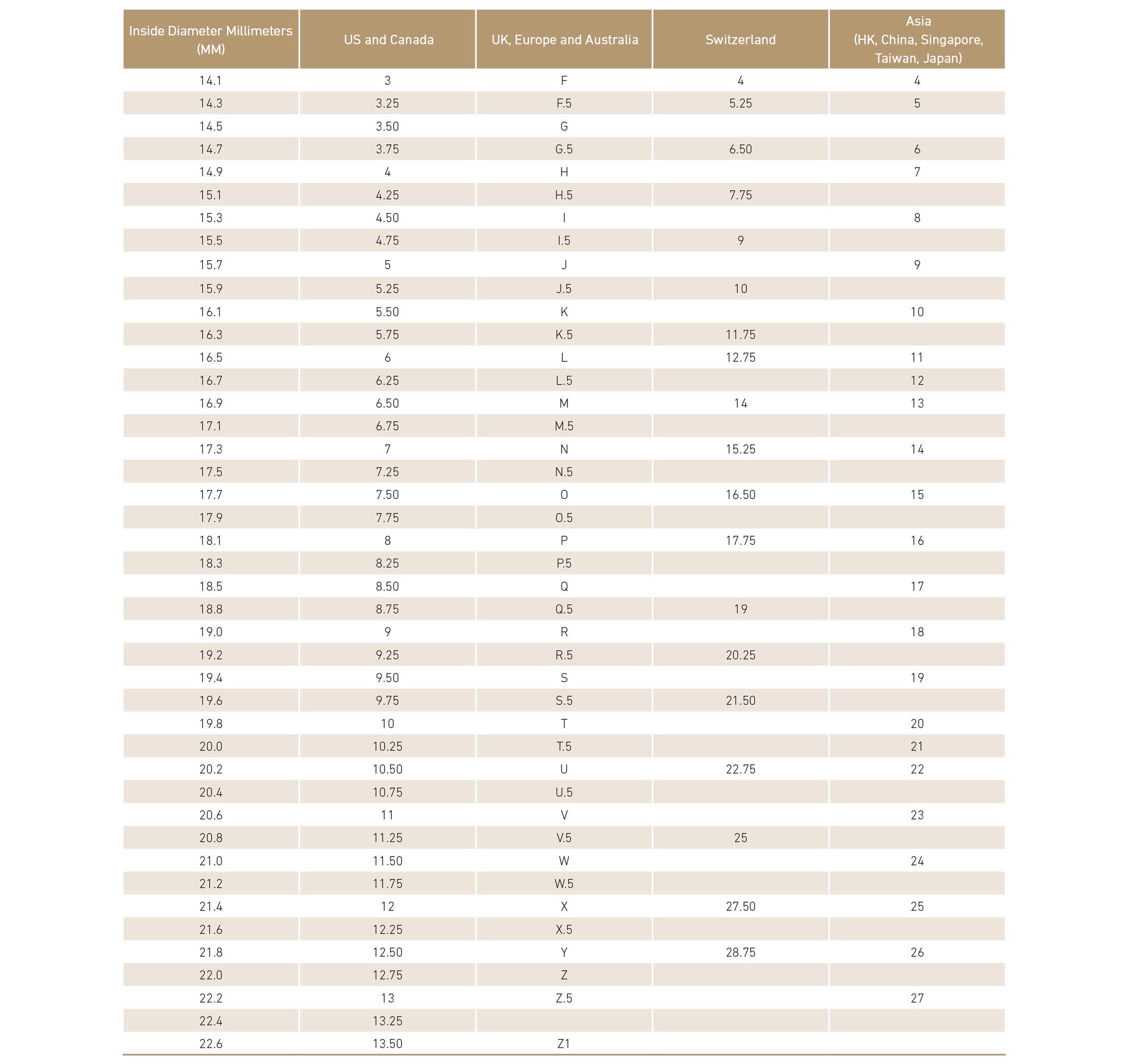
Version gia-v1 contains 43 rows from the GIA international ring-size chart: US 3 through US 13.5, including quarter sizes. The chart, converter, calculator, measurement results and printable PDFs use this same dataset. Circumference is calculated from each source diameter, not copied from a second chart.
US, UK / Australia and Japan / Asia labels retain GIA's entries. Blank labels stay unavailable; half UK letters and the source's Z1 label are preserved. EU / ISO is an approximate rounded circumference in millimetres, not the Swiss column in GIA's chart. Reverse EU conversion can match several source rows and shows all of them.
Retailer charts differ. At US 9, GIA gives 19.0 mm and Tiffany gives 18.9 mm. We keep GIA's value rather than blending sources. Compare the physical measurement with the retailer's own chart.
Measurement results and the calculator show common whole and half US sizes. Within 0.05 mm of a midpoint between those reference diameters, both neighbours are shown. The full chart and converter retain quarter sizes. Values outside the source's 14.1–22.6 mm diameter range keep their physical measurement without an extrapolated regional label.
Millimetre values are retained through calculations. Calculator units convert using 10 mm per centimetre and 25.4 mm per inch. Display rounding and the midpoint window are presentation rules, not measurement-accuracy claims.
Repeat measurements and fit guidance
These consistency thresholds are product rules, not tolerances prescribed by GIA or ISO:
- Existing ring: two measurements within 0.3 mm are averaged. Otherwise, a third is requested. If all three agree within that span, the middle value is used; otherwise, the closest agreeing pair is averaged. If no pair agrees, start again.
- Finger circumference: two fresh wraps must agree within 1 mm. Their mean is used; a larger difference requires a fresh pair. This applies to physical-ruler entry and the calibrated screen line.
- Calculator and converter: these use the measurement or known size you supply and do not perform a physical repeat check.
Repeat agreement checks consistency, not correctness. A consistently wrong calibration or a tightly wrapped strip can still produce agreeing measurements.
Blue Nile's guidance discusses changing finger size, knuckle clearance and wider bands. Our optional wide-band note suggests considering about half a US size larger; it never changes the measured millimetres or measurement-based result. It is a fit suggestion, not a universal adjustment.
Printable guides and verification limits
The A4 and US Letter PDFs are generated at build time with vector geometry, the dataset version and verification date. Print at 100% / Actual Size and verify the 50 mm line and 85.60 × 53.98 mm card box. Match a ring to the centre of the PDF's thin circle line. Website previews are illustrative.
Automated tests check conversion rules, repeat handling, screen geometry, PDF dimensions and browser behavior. Physical-device calibration accuracy, a physical iPhone check and real-printer measurements remain unverified. Screen emulation and correct PDF geometry cannot establish physical measurement accuracy.
Use a round, undistorted ring or a carefully marked strip. Temperature, knuckle shape, band width, paper thickness, stretching and alignment can affect the estimate. See the measuring instructions and fit references.
Sources and references
- GIA: Accurate Determination of Finger and Ring Sizes and its international reference chart. Canonical dataset source; transcription verified 2026-09-12.
- ISO/IEC 7810:2019: Identification cards — Physical characteristics. The IEC public abstract for the earlier 2003 edition explicitly lists the nominal ID-1 dimensions, 85.60 × 53.98 mm. This is a dimensional reference, not certification of this tool.
- Tiffany: Ring size guide. Interior-diameter and wrapped-length methods, plus an independent example of chart variation.
- Blue Nile: How to measure your ring size and ring fit guidance. Temperature/activity, knuckle clearance and wider-band fit suggestions.
Reference links and supporting guidance reviewed 14 September 2026. These sources do not endorse or certify this application.
Verification history
- : established gia-v1, reviewed source anchors and conversion behavior.
- : verified manual entry, calculator, converter and the complete chart.
- : checked vector PDF geometry; reviewed measuring instructions, methodology and the app's storage/network behavior. Physical verification remains pending.
How your data is handled · Explore the size chart · Measure a ring · Calculator · Converter · Printable sizer